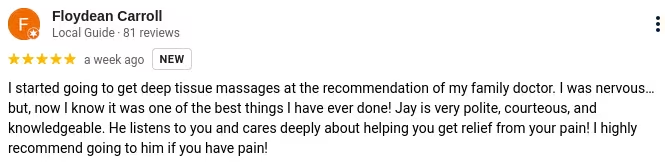
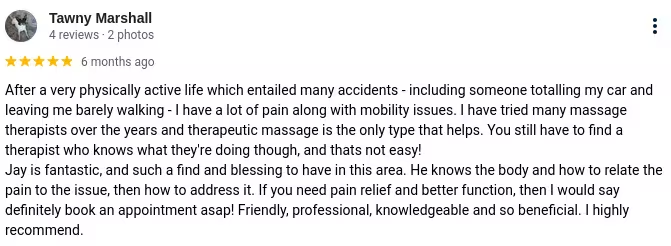
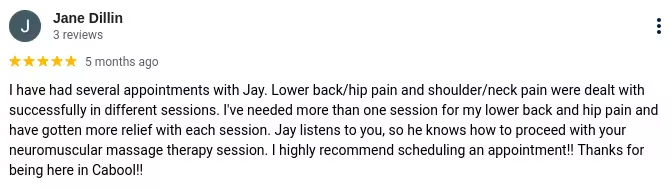
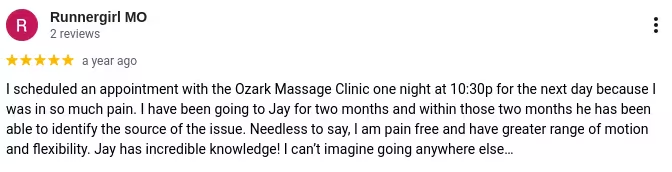
Hi, I'm Jay Ashford Gore, a licensed massage therapist with over a decade of experience.
I studied neuromuscular therapy as part of a 900-hour program at Professional Massage Training Center in 2014 and have continued deepening my skills ever since — because I've seen what it can truly accomplish.
I created Ashford Neuromuscular to further fulfill the potential of massage — offering something different that breaks preconceptions, transcends stigma, and rethinks the format — all to stay sharply focused on driving real results. While many therapists try to be everything to everyone, my mission is simple: helping you feel and function better.
Experience Results
If your pain changes with movement or position — better when you sit, worse when you stand, triggered by a specific action, or radiating somewhere unexpected — there is a strong likelihood that the work I do can help you. I'm Jay Gore, and I bring mobile neuromuscular therapy directly to your home or office in Ozark, Nixa, and Springfield.
Neuromuscular therapy is a results-driven approach to soft-tissue treatment. Unlike a typical massage, every decision in a session — where to work, how much pressure, how long to hold — is guided by your feedback and by what I can observe in your movement, strength, and symmetry. We're not here to relax you. We're here to fix something.
Most muscular pain is referred pain — the spot that hurts is rarely the source of the problem. I use hands-on evaluation to trace the dysfunction to its origin, then apply targeted pressure to the structures involved. When we find the right tissue, you'll often feel a distinct reaction — not just pressure, but a sensation that travels, refers elsewhere, or simply feels unmistakably like "the spot." That reaction is the signal we work with. We hold appropriate pressure there until the sensitivity drops, which tells us the tissue is responding. That's where the real change happens.
Sessions are done through clothing, which allows free movement between assessment and treatment. Modest athletic attire works best.
Book an Appointment
For mobile service in the Ozark - Nixa - Springfield area use the calendar below or call/text 417-551-9993.
Booking online requires third party security cookies from our booking app Calendly. Click the button below to accept.
Conditions that Respond to NMT
Neuromuscular therapy is effective for a wide range of conditions involving muscular pain, restricted movement, or referred symptoms. If you've been told your pain is "just muscle tension," or if you've tried chiropractic care without lasting results, soft-tissue treatment may be the missing piece. Click any condition to learn more.
Sciatica and sciatic-pattern pain
True "sciatica" is when the sciatic nerve is being trapped in the disk itself — this is more in the realm of chiropractic. There are however as many as four soft-tissue problems that present with the same or similar pain patterns and are often misunderstood as sciatica. This includes the infamous "piriformis syndrome" where the sciatic nerve has become trapped by the piriformis muscle. I have found that this can sometimes occur in the smaller rotare muscles right on the spine. The sacro-tuberous ligament and gluteus minor can mimic similar pain patterns but don't actually trap the nerve. Still less related but sometimes confused with sciatica are pain patterns that wrap around the front of the thigh. These can be caused by nerve entrapment in the hip flexors.
Shoulder impingement
This occurs when the head of the humerus sits too deeply in the joint, creating more friction and often resulting in limited range or strength overhead. My approach is to work all the way around the rotator cuff and the deltoid with particular emphasis on supraspinatus to rebalance tension and take pressure off the joint.
Thoracic outlet syndrome
If you are experiencing pain down the arm, numbness, weakness, or swelling, test for yourself — bring both arms 90 degrees straight out to the side, then point your forearms straight at the sky, open and close your hands repeatedly. If you can't maintain this activity for 3 minutes without provoking your symptoms, that indicates thoracic outlet syndrome. The nerve and blood supply to the arm is compressed where it leaves the neck. My approach is to first assess your posture. It's important we address any distortion in the neck and shoulder area while we treat the middle and anterior scalenes, two muscles that sandwich those supplies. In some cases they can be too tight, but in others they are actually stretched and weak — in either case causing the outlet to collapse. Be sure to give neuromuscular therapy a try before you commit to the surgery for this condition, which typically removes the first rib.
Low back pain
There are many possible causes for low back pain. I start by assessing the position of the hips because if we leave them in poor position, you're likely to have recurrence even if we do a good job addressing the pain elsewhere. You can cut down our assessment time by trying this ahead of time - is it difficult to rotate (trunk twist) to one side or the other? What about side bending, directly to your right or left? Now flexing forward or extending back? If you found a restriction or provoked your symptoms with any of these movements, take note, this information helps narrow it down. A quick tip that applies to pain associated with prolonged sitting - keeping the low spine extended (tail back or out) stretch the hamstrings for 90 seconds+ until you get a lengthening response. This can take pressure off the low back and help get you through a tough day.
Neck pain and stiffness
#1 thing you should know here, if you wake up this way, look in the mirror first, if the pain is on the same side as a low shoulder - DO NOT STRETCH THE UPPER TRAPESIUS! This area is already on a stretch, it's behaving weakly, and it's painful because it is becoming ischemic (lack of bloodflow). Instead stretch the pectoralis major and minor, serratus anterior, and latissimus dorsi. This can take pressure off the neck by reducing the downward pull on the shoulder. My approach is to lengthen theses muscles, work to correct any head forward posture, and then get vigorous in the painful and stiff area to bring in blood flow. This is a good place for ice-heat-ice in 6-8 minute intervals starting and ending with ice. Note this only describes the most common scenario.
Tension headache
My approach is to address the suboccipitals (at the base of the skull), and the anterior neck muscles low in the front. It sounds a little weird, but this is where most headaches originate from, and these anterior muscle tensions contribute to head forward posture. Often the jaw muscles, connective tissue on top of the head and forehead muscles can be implicated as well. Important to note here that while neuromuscular won't address the root cause of migraine, tension headache is often a trigger for migraine, so keeping these under control may help some migraine sufferers manage their symptoms.
TMJ dysfunction
Temporomandibular joint dysfunctions can cause jaw pain, clicking and popping, limited mouth opening and headache. My approach is address the masseter, temporalis, and sometimes the pterygoid muscles. In one instance a client was using mouth guard style devices to improve the position of the jaw, it seemed to help to have them wear those during treatment, training the muscles to that new position.
Carpal tunnel syndrome
CTS is caused by compression of the median nerve as it passes through the wrist. Neuromuscular helps by reducing tension in the surrounding muscles and improving fascial glide (ability to move indepently of one another) between those muscles and the nerve. Perhaps more importantly, the carpal tunnel is not the only place the median nerve can be trapped, and I'll check for that. I consider thoracic outlet syndrome (see above) more common, as we rule that out I look at possibilities working down the arm from there.
Tennis elbow and golfer elbow
Medial and lateral epicondylitis is an overuse injury resulting with inflammation in the tendons attaching on their respective sides of the elbow. Intervene with ice only for the first 48 hours then ice-heat-ice in 6-8 minute intervals started and ending with ice. When you see me we'll address the forearm flexors and or extensors, then branch out to other areas of the arm, you're not likely to accrue overuse in isolation.
Hip pain
A lot of different things are described as hip pain. My approach is to assess the symmetry of the hips, their position in relation to the spine, and the position of the tailbone. From there I work to balance tension around that whole system. I'll also look at the range of motion and especially rotation of the femur. In the cases where my work hasn't helped, the client often later learns that they were already bone on bone.
Knee pain
Often more straightforward in my view, the muscles most implicated in knee pain include hamstrings (can alter the position of the menisci or cause swelling around the knee), quadriceps (when imbalanced, pulls the patella out of track), popliteus, and plantaris. In some cases we may have to address the way the ankle is functioning to put the knee on a proper base.
Plantar fasciitis
Many therapists will just pound on the bottom of the foot. My approach is to first work the gastrocnemius and soleus muscles in the calf which share the achilles tendon attaching at the heel. This takes tension off the bottom of the foot indirectly. Then I'll go slowly working side to side across the width of the foot with whatever amount of pressure feels like a 4/10 to the client, pausing on points that feel reactive until that activity subsides. You can do this part yourself at home with a tennis ball but don't over do it. If the bottom of the foot is red, hot to the touch, or swollen, I skip it entirely - just apply ice.
Sacroiliac joint hypomobility
Symptoms of SI dysfunction include pain that mimics sciatic, limited straight leg raise, pain in bending over especially with rotation, pain at the joint itself, pain in the groin of the same side, unexplained pain in the lower abdomen (could be mistaken as visceral), unexplained rectal pain, unexplained gastrointestinal or genitourinary pain, unexplained sexual dysfunction and dyspareunia. It's a condition that can start as a minor inconvenience but becomes increasingly life altering as severity increases. Firstly we have to be sure we're working with HYPOmobility (not enough movement) rather than HYPERmobility (too much movement) - which I can't address directly (HYPERmobility falls more in the realm of Physical Therapy). I confirm with two or three separate tests before I intervene. Once we confirm, the treatment is simple, relaxing and noninvasive (but would worsen HYPERmobility - thus the precaution). One client with HYPERmobility insisted my work was helping, but we took a very indirect approach, mostly keeping the muscles involved in the compensation pattern in good shape which seemed to keep pressure off the SI joint perhaps allowing time to heal - important to note that is strictly anecdotal.
Whiplash
Interestingly enough, I treat this with the low back pain, stiff painful neck, and headache protocols above combined. Every case is unique but that is really the starting point. One difficulty with whiplash is you can continue to experience new symptoms from it for up to 5 years after your accident. Be sure and get checked out by a doctor after your accident to rule out fractures before you see me for soft-tissue.
If your condition isn't listed, reach out — the movement-and-position test above applies broadly. If your pain responds to how you move or hold yourself, there's likely a soft-tissue component worth addressing.
FAQ
Can neuromuscular therapy help me?
Here's a simple test: does your pain change depending on your position or movement? If sitting makes it better or worse, if a certain action triggers it, or if it travels or radiates — that pattern almost always has a muscular component. And muscular dysfunction is exactly what neuromuscular therapy is built to address.
I've seen positive results with clients who had been living with pain for years, including those with diagnosed conditions like early-stage rheumatoid arthritis or who had undergone joint replacement. An underlying condition doesn't rule out a muscular component — and addressing that component can meaningfully reduce pain and restore function even when the underlying condition remains.
How is this different from deep tissue massage?
Most massage — even deep tissue — is pressure applied to a depth. Neuromuscular therapy uses pressure as a tool for locating and releasing soft-tissue dysfunction. The difference is this: I'm not working to a depth, I'm working to a response.
When I apply pressure to a dysfunctional area, the tissue reacts — you'll often feel the sensation travel, refer to another location, or simply feel more intense than the surrounding tissue. That reaction tells me I've found the right spot. I hold appropriate pressure there until the sensitivity drops, then we move on or follow in with more if the tissue allows. Your feedback drives every decision. This is the opposite of a massage where you're supposed to tune out.
How often should I book, and how long do results last?
For active or acute conditions, weekly sessions give the best results early on — you want to make progress faster than the dysfunction reasserts itself. Muscular issues tend to recur because we return to the same movement patterns that created them. Treatment holds best as part of a broader self-care plan that includes stretching and exercise.
Once things are under control, most clients shift to maintenance visits every one to three months. Think of it like going to the dentist — you don't wait until it hurts.
Do you come to me?
Yes — I'm fully mobile and serve clients at their home or office throughout Ozark, Nixa, and the Springfield area. I bring everything needed for the session. You'll want a cleared workspace of approximately 6 by 10 feet. The convenience means no driving home stiff after a session — you can go straight to rest or stretching in your own space.